
It’s official, the Church of England is doomed, we’ve got about nine years until the collapse is widespread and undeniable, then roughly another ten years before the Church will be “no longer functionally extant.” And by official, I mean the First Church Estates Commissioner speaking to General Synod. Except not recently, this was in July 2011 (Church Times, 15th July 2011). So the nine years was up in 2020 and the final collapse is, well, round about now.
People have been predicting the end of the Church of England regularly since the Great Heathen Army of 865 (which was, as it happens, a close run thing) but eventually what Ivar the Boneless failed to achieve will come to pass. The Church of England is organisationally a human institution, and like all human institutions it is mortal and fragile and will one day be “no longer functionally extant” – except it wasn’t 865, and it wasn’t 2020, and it doesn’t look like being 2026 or even 2030, so when?
What Aethelred, Alfred and Edmund didn’t have in 865, but we do have, is the modern study of collapse and resilience in complex organisations and organisms. This secular wisdom can help us to describe what the actual collapse of the Church might look like, and it might help us to make better decisions.
It seems like a timely question, popular writers like academic and Church of England reader Dr Francis Young have written recently about the “structural collapse” of the Church of England, the moment when the ability of the institution to respond effectively has become so compromised that the risk of uncontrolled collapse is real. Young’s area of research is the collapse of religions, and he is close to the centre of the Church of England, and he’s not alone, the data really is dismal, if anything worse now than it was in 2011. Even more recently the Church Times reported on work by Canon Robin Gill and Professor John Craven, this time pointing to “financial disaster” and calling for “ruthless” action.
This series is in four parts. I begin by identifying some of the key changes and continuities in the Church of England that I have experienced in my ordained ministry. I was ordained in 1994, so I look across the 32 years since then, and also back thirty years before 1994 to the early 1960s. I will use personal experience, what it “felt like” to me, and also publicly available data from the Church of England.
In the second part of the series I will introduce insights from the secular study of collapse and resilience. The Church isn’t simply a biological system, an economy or an empire, (although we do borrow language from them to describe ourselves) so I don’t propose to simply say, “this theory says x – that must be what is happening” but I will show that there are helpful insights and approaches. Most of all this approach can help us to ask the right question and test what we think we know against evidence.
In part three I will look at how the Church of England is responding to change, in particular considering those responses through a complex-adaptive-system lens, and alongside them suggest some useful lenses from theology and ecclesiology.
Finally in part four I will draw these threads together to see if we can answer the question about collapse, and how leaders might best respond. Spoiler; the answer isn’t a simple “yes” or “no” to the collapse question, but I do conclude that there are some important lessons from the secular study of collapse and resilience, and that we don’t seem to be learning those lessons.
There are two questions at the heart of this series; the first is whether the Church of England is really at a “tipping point,” Francis Young’s “point of structural collapse”? The second more fundamental question is whether we believe that God still loves the Church of England, has God abandoned us, do we serve a faithful God, or has our unfaithfulness led us into the valley of the shadow of the death of the Church?
Part One “Change and decay in all around I see”
When Henry Francis Lyte wrote the words of “Abide with me” in 1847 he knew that he was dying of tuberculosis, the hymn was sung for the first time at his funeral. More than anything else, the hymn is a prayer for God to be present in the face of human fragility and the reality of mortality. This seems like a good place to start.
I was ordained in the Diocese of Salisbury in the summer of 1994, I became one of more than 10,200 stipendiary clergy in the Church of England. The Church’s official membership list- the Electoral Roll- stood that year at 1.4m, we baptised roughly a quarter of all the children being born in England, and about a million people came to church on a typical Sunday.
We will see that all those numbers are much higher than today’s, but back then1994 didn’t feel like the sunny uplands of the Church of England. Data we all knew was already showing what we thought of as steep decline in most metrics; from 1960 to 1994 the number of stipendiary clergy had fallen by more than 20%, Electoral Rolls had halved while the population of the nation rose steeply, in 1960 we had baptised around 60% of children born in England compared to 25% of children in 1994. Easter Communions fell from almost 2m in 1960, to 1.3m in 1994.
The official 1960 report, “Facts and Figures about the Church of England” counted the number of children enrolled in Sunday school, just over a million aged 3 to 14, about 15% of that age-group nationally. This was deemed lamentable and the report shows how the numbers had been showing a steep decline over time. Rather wonderfully it is noted that “the decline in Sunday school attendances is inversely related to the number of motor-cars” and it has a little table to show this.
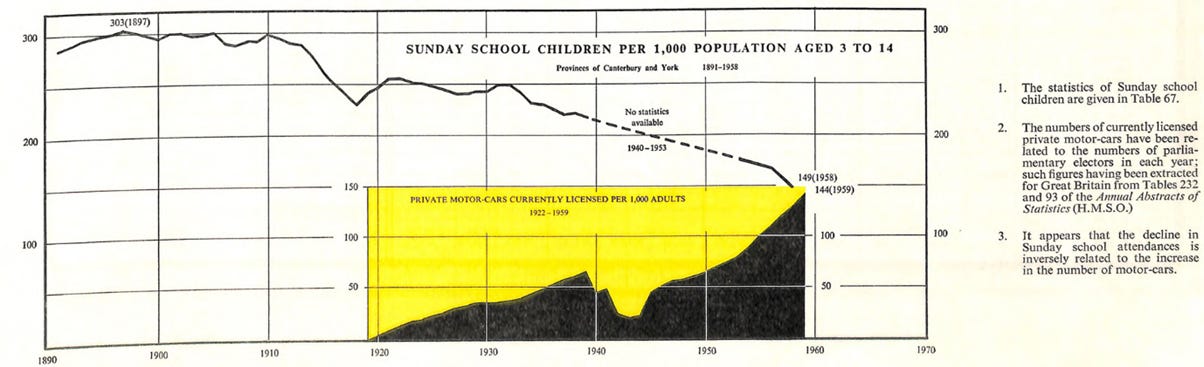
By 1994 the Church had stopped blaming the private ownership of motor-cars and tellingly had also stopped recording numbers enrolled in Sunday school, but had started counting numbers of children under the age of 16 attending church (usually including those in Sunday school), these numbers were also falling sharply, down to 200,000 in 1994.
We knew in 1994 that the Church wasn’t what it used to be, and we didn’t need tables or data to tell us. We had all watched arguments about the marriage of divorcees in church and the now rather quaint looking divisions that arose from that. More significantly the Church had at last just decided to ordain women as priests and some of us were seeing friends and whole congregations preparing to leave the Church of England. There wasn’t alternative episcopal oversight and a quasi-third province yet, but the foundations of division were being laid.
Most of us ordained in 1994 had been born at a time when the Book of Common Prayer was still the common thread across traditions in the Church, we could be “high church” Prayer Book or “low church” Prayer Book, but the liturgy (and much of the music) would have been common across the Church of England in the early 1960s, but by 1994 that was no longer the case, the worshipping life of the Church of England was rapidly atomising.
A year before my ordination, in 1993, the Church of England had been rocked by news that the Church Commissioners had “lost” £800m in disastrous commercial property investments, that was more than 1/3rd of the total value of the Commissioners’ funds, hence while still at Theological College we were told by a stony faced archbishop that we should not expect the Church of England to be able to afford our stipends and pensions indefinitely - this isn’t a job for life, he warned. But it was ok, the other archbishop told us, this was the “Decade of Evangelism”….
32 years later, in the latest published figures, there are 6,600 stipendiary clergy (a fall of more than a third from 1994, half the 1960 number), Electoral Rolls are down by almost 40% against 1994, baptisms down by an astonishing 70% - fewer than 10% of children are now baptised in the Church of England before they are one year old, and just over half a million people come on an average Sunday, that’s half the number in 1994.
If the Church of England ever was “a Christian presence in every community,” we are not now. There are whole communities in hamlets, estates, urban and suburban centres and certainly in civic, industrial, sporting, leisure and online communities where either there is no meaningful Christian presence at all, or the presence is not the Church of England.
Children and young people.
Arguably, the data for the fall in the number of children that the Church of England engages with through its local churches are the most worrying datasets here. The number of children counted as in church on a Sunday has fallen from over a million in 1960, 200,000 in 1994, to around 70,000 now. These dire numbers don’t tell the whole picture, there is a lot of “work with children” not captured here, it is often vital work and “it counts” in terms of the Kingdom, of course, but if we look at children as part of the worshipping life of the Church of England the picture is dismal.
Simply from the published data, but also in the impact on the local life of the church, the collapse in ministry among children and young people is perhaps the single most significant change in the life of the Church of England since the 1960s. It is impossible to argue that this is anything less than a profound decline with important long-term consequences for the reach of the Church into the future life of the nation.
One area of work with children has continued to flourish since the 1990s; the work of church schools. The number of Church of England state schools has remained more or less steady over the last 32 years at around 4,600, the proportion of children educated in Church of England schools nationally has crept up slightly and is now at around a quarter of the primary sector, a million children. Our reach in the secondary sector is much smaller at around 8% of schools, but taken together this means that on a typical Monday there will be more people worshipping in our schools than gathered to worship the day before in our churches, a piece of data that has not been lost on Humanists UK who have been kind enough to celebrate the strange achievement.
In the following sections I want to look at three other areas of profound change in the Church of England since 1994; patterns of ministry, the pastoral offices, and the effectiveness of the national church institutions. I will finish this part of the series with some important things that haven’t declined, or where the decline is much less steep.
Radically changing patterns of ministry
Some key numbers in the ministry of the Church of England have gone “up”. As the age profile of the clergy workforce has changed the number of retired and other clergy in active parish ministry but not receiving a stipend, typically clergy with Permission to Officiate (PTO) is higher now than in 1994, up from 7,500 to 8,400, and way higher than the 1960 count of retired clergy with PTO, which was just 1,200.
This is part of one of the most profound changes in patterns of ministry in most of the country since the 1990s; stipendiary clergy are now no longer the default person leading worship on a Sunday morning in thousands of churches. The person at the front is now much more likely to be from one of two (currently) growing groups; retired clergy with PTO, and commissioned lay people, usually called “Worship Leaders”.
In the Diocese of Truro, according to the latest published national data, PTO clergy outnumber stipendiary clergy by 3:1, the ratio of worship leader to stipendiary clergy is closer to 4:1 (not every priest with PTO or every worship leader will take a service every week, and Truro is at one end of a continuum with those ratios).
I highlight three significant changes in the pattern of ministry in the last thirty years;
· In many dioceses the Church now relies heavily on retired clergy with PTO to sustain anything like a regular pattern of services at a local level
· There will be benefices and deaneries where on a typical Sunday most of the services are led by commissioned lay people,
· Far fewer churches will now have a service every Sunday.
The national reduction in stipendiary clergy is 34% since 1994. Hence, at the time of my ordination there were 232 stipendiary clergy in Salisbury, latest national figures show this at 180, a 22% reduction, not as bad as the national headline, Winchester where I moved for my first incumbency is down 35%, close to the average. In Truro the reduction is worse, at 41%, but in Durham the reduction in stipendiary clergy in 32 years is 50%, and in Carlisle 52%. That’s half their stipendiary clergy gone in 32 years.
If over time some dioceses have seen much greater losses than the national average, then others saw much more modest reductions, in Oxford there are fewer stipendiary clergy, but “only” 20% fewer, matched by Guildford, and in London, according to the national figures, they have exactly the same number of stipendiary clergy today as on the day I was ordained – 0% change.
Change and decay, in some at least, I see.
Looking to the future, further falls in clergy numbers are “baked in” because of the timeline from someone thinking, “hmm, I could do that (better than him)” to “The Lord be with you,” is around six years. In ten to fifteen years two scary lines on the charts will cross; stipendiary numbers will continue to fall, and the number of active retired clergy will quite suddenly peak and then fall steeply. In most dioceses there will be a third scary line, the average age of congregations is likely to mean fewer willing and able lay worship leaders.
Collapse in the pastoral offices.
For at least the first ten years of my ordained ministry the pastoral offices, baptisms, weddings and funerals, were at the core of our work and were of such numbers that they could, and did, form the basis of growing the local church. In the last thirty years these ministries have collapsed. These are the national figures.
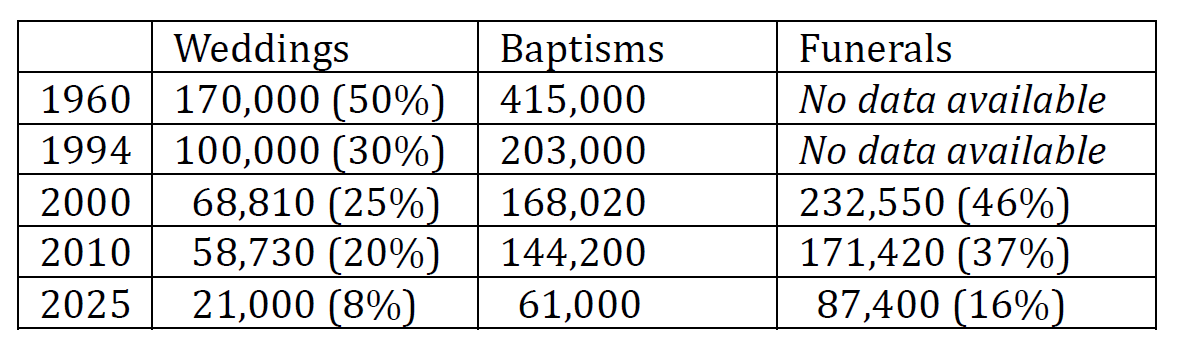
The figures in brackets above show the rough proportion of the total marriages in England and proportion of deaths in England in each given year for weddings and funerals, however because of changes in the way that data are collected, timing differences, and the way UK statistics are shown these percentage figures should be taken as approximations.
This is another dataset where there are significant differences within and between dioceses. The table below shows the number of baptisms in Truro, Exeter, Carlisle, Durham and London in 1994 and 2024 with the percentage change.
The Church no longer provides the “live birth” numbers by diocese, so to get a sense of relative scale the last column shows the number of baptisms in 2024 per 1,000 of the total 2021 census population. The national “change” figure was -70% and the per 1,000 of total population of England (note, population not the proportion of live births) was 1.0 baptism per 1,000 head of population per year.
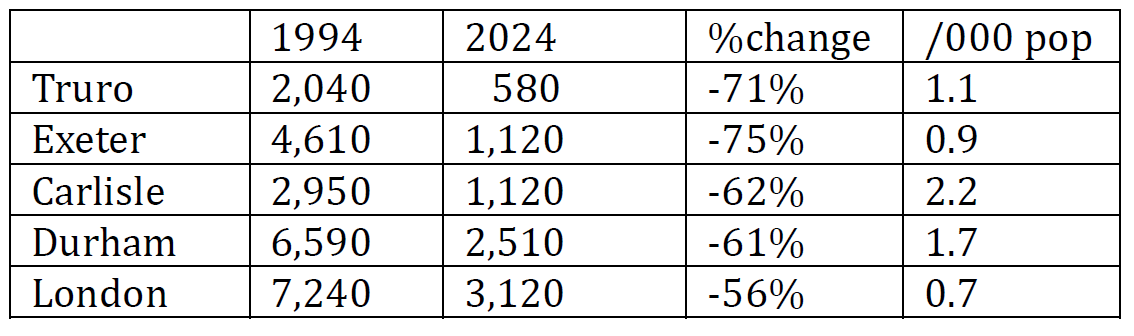
This little table shows how understanding the health or otherwise of the Church of England is complex. Durham, Carlisle, and London for instance showed a roughly similar decline in the number of baptisms over time, but these figures suggest that Carlisle and Durham continue to “reach” much further into their communities than the church in London, within each diocese the picture will be even more complex.
The collapse in ministry through the pastoral offices tells us something important about the place of the Church of England in the spiritual and religious landscape of England, it also tells us that “growing back” will be much harder than would otherwise be the case.
In parish ministry I had a rough and ready expectation that in any given year around one in ten of the families I met for weddings or baptisms would still be regularly in contact with the church a year later, we usually did better than that. When I was conducting 60 baptisms and 25 weddings a year that became a significant basis of growth, it allowed us to create intentional pathways into the life of the church, and it could more than keep pace with people moving away, deaths, and general falling out with the vicar and or God… In other words, the front door was much bigger than the back door, the pastoral offices no longer offer that opportunity and as congregations are typically now smaller and older the “back door” has widened.
Effectiveness of national institutions.
The 1990s saw the dismal and very public failure of at least one of the Church of England’s national institutions, the Church Commissioners’ reported “loss” arising from failed property investments. Arguably, the much vaunted “Decade of Evangelism,” much wider than the Church of England but supported by the national “Springboard” team and resources in every diocese also struggled to achieve anywhere near the impact it sought with published academic research generally concluding that most dioceses were in a “significantly weaker position at the end of the decade” than the beginning, the Diocese of London being the usually cited positive outlier. However, the 1990s also saw significant work where the national church did apparently manage to navigate significant “fault lines” in the Church, most notably the decision to ordain women, and the introduction of “Common Worship” to replace the Alternative Service Book (ASB).
It is likely that a significant contributor to the common perception of “collapse” in the Church of England today is the apparent failure of national church institutions to do the things they set out to do. The most obvious and damaging example must be the inability to restore confidence in safeguarding in the Church of England and the highly public failure of Archbishops’ Council, General Synod, the archbishops, and the House of Bishops, to lead credible change in this area. Alongside this, the failure of the national church to implement its own structural reform, (the “National Church Governance Measure” which failed to be adopted in 2026,) the apparent failure of “Project Spire,” and the high profile resignations and suspension of senior bishops, combine to paint a dismal picture and erode confidence.
The national church has, arguably, failed to respond to the reported financial challenges facing many diocesan boards of finance, offering only short term responses that fail to address the structural weakness of around half of all DBFs and the imminent failure of a handful of them. Whether the national strategic funding programme (Strategic Mission and Ministry Investment Board – SMMIB) is any more effective than the Decade of Evangelism at reversing apparent decline is yet to be seen, but its approach is certainly not unambiguously popular, and its impact at a national level at best unproven.
We will see later in the series that the ability of an organisation to respond effectively in the face of acute challenge is an important factor to consider when discussing resilience and collapse. Some key elements of the national church institutions do clearly continue to operate effectively, but there is enough apparent weakness, particularly in the area of strategic priorities, and in ways that impact parish life, to give cause for real concern.
Enduring faithfulness of the local church
There is any amount of data that shows reducing numbers and increasing age profiles. However, some of the data doesn’t look like decline;
· The Church of England still has lots of money, the dioceses (DBFs) have generally got much poorer in the last 32 years, but the Church Commissioners, and, rather unfashionably, PCCs overall have got richer. The money might not be in the right places, but in most places and nationally we will run out of people long before we run out of money.
· There are almost the same number of churches in the Church of England 32 years later, just 3% fewer, down from 16,000 to 15,500, and given the increasing number of “fresh expressions” not in church buildings, then the number of locations where the Church of England is present in some form may well be higher now than it was in 1994.
· The number of parishes, and therefore the number of Parochial Church Councils, is relatively stable, only down 7% from 13,000 to 12,000. At their best, Parochial Church Councils are the local organising committees for the mission of the Church, they are the grass-roots activists leading the living witness of the Gospel, and they have proven remarkably resilient. Survival alone does not indicate health, neither does growth of course, but there is something important to understand here.
My own experience of small, fragile local churches is that they are often kind and generous, often yearning and praying for the Spirit, and most of all they are faithful, season by season, year by year. They’re not always like this, they can be unhealthy, inward looking, resentful and grumpy, so can I. They may have become almost impossible to join, and yet the church that 32 years ago was a dozen people with an average age in the seventies, no children, sceptical of diocesan plans and strategies, immune to decades of this or visions of that, has now become a church of nine people with an average age in the eighties, obviously not the same people, but mysteriously enduring. I don’t know if they can do the same thing in another 32 years, I suspect not, but that, to a significant extent, will depend on the decisions made in this generation by bishops and others.
Fast falls the eventide?
I began this section with the words of “Abide with me” and the reality of our mortality, Henry Francis Lyte looking his own death squarely in the face. The reality of death was a good place to start because of course the Church of England is dying, everyone I love is dying, every human body and every human institution will eventually collapse, that doesn’t mean I don’t also believe in the Resurrection of the body, and the Christ inhabited body of the Church that will last until the end of time, and it doesn’t mean that the Church of England is on its death bed yet.
My Dad is in his mid-nineties, he has got cancer, we don’t have any illusions, but the time to worry about the amount of double cream he puts on his apple pie has now passed. I think that points to the question we are asking about the Church of England. Is it time to say to the old man that a lay-in is fine on most Sundays and to look around at who will be there to inherit the piano? (there is no piano). I have heard bishops refer to parish ministry in some places as “hospice ministry” and national strategic leads suggest that giving more money to small local churches would be “subsidising and prolonging decline.” Or, perhaps, are we the Church not in the end times at all, not old men in their last autumn, but a callow youthful church in an awkward messy puberty? Is what we are experiencing the pain of putting away one way of life and the picking up of another? Is it discipline we need, focus, and a plan, to be told to get out of bed, stop feeling sorry for ourselves because we’re wasting daylight…
Next time, butterflies in Hawaii, the secular study of resilience and decline.